Alamance County has lots of cemeteries, places set apart for burial or entombment of the dead, reflecting geography, religious beliefs, social attitudes…
Over time, Edwin Michael Holt helped make Alamance County an essential player in producing textiles, also giving us the Alamance Plaid. At his death, he was possibly the richest man in the state.
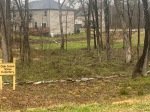
He owned 1,600 acres, located south on Highway 62 South in Burlington, NC, maintained by some 50 slaves. He established one of his mills in what is now the Historic Mill District. At the edge of the Historic Mill District is an upper-middle-class neighborhood. Located inside this community is a slave cemetery with no markings, no hints — no green trees bending to create a trail marker, identifying this location as the resting place for the individuals who worked the land.
Some view cemeteries as a secular space — a space to house the dead. Others as holy grounds – where the bodies are arranged in neat or uniformed rows, facing the rising sun.
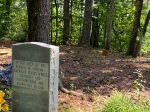
Over the years, I have visited many burial sites, some well maintained, with walking trails, neatly arranged tombstones, flags on each grave. Some relatively simple, such as the Moravian cemeteries, using the same style tombstone on every tomb, making the statement that in death, we are all equal. Maybe. Early African American cemeteries were makeshift burial plots on borrowed land, making them difficult to visit or locate.
(img)
Our social attitude towards death and burial determines how we treat the dead. On Southern plantations, they would bury dead slaves in pine boxes on their owners’ land. They identified the graves with a simple stone marker, and for the most part, the planters did not keep proper (death and burial) records.
In recent years, we have discovered more and more slave cemeteries; however, I am not sure we know what to do with them. What does it mean that our attitudes towards slave cemeteries have evolved as a people?—We can’t agree on the response.
Sometimes the site can be “abandoned” — a legal term, making it available. The implication is, the descendants don’t care, so why should the public. There are further issues. One is economics. To properly maintain a cemetery takes resources. Depending on the state or county in which you live, it’s referred to as “perpetual care,” “permanent care,” or endowed — funds used for repair and general maintenance, such as landscaping and lawn mowing, roads, and paths.
It’s also about ownership. Plantation owners buried slaves on their land, and when the plantation was sold, the new owner had plans for the land. North Carolina Code – General Statutes Article 10 – Access to and Maintenance of Private Graves and Abandoned Public Cemeteries (2005) states that with the consent of the public or private landowner, you can enter another’s property to discover, restore, maintain, or visit a private grave or abandoned public cemetery. It must be difficult asking the new owner to grant you access to their land, asking that they preserve or at least allow you to maintain your ancestors’ resting place — individuals with whom they have no connection; that’s too much to ask.
Then finally, politics. What we do, if it’s preserving or not — it’s political expediency, an unfair solution. In 1978 the state put together a legislative study committee (the Abandoned Cemeteries Study Committee) to make recommendations for their protection and/or preservation. The committee gave county commissioners the responsibility to appropriate whatever sums are deemed necessary for the upkeep of cemeteries. They also made it possible to remove remains, providing the mover gives thirty days’ written notice to the next of kin. That’s interesting, given that plantation owners’ records were not adequately kept. Protection of a slave cemetery, when discovered, should be our priority. It’s the right thing to do.
It’s challenging enough to figure out how to memorialize a loved one. We have to consider how often to visit the gravesite — what to do while you are there. Some of us leave flowers, a practice that dates back thousands of years when the ancient Greeks placed flowers on the graves of fallen warriors. When I visit the graves of soldiers, I sometimes leave a penny. My Jewish friends talk about making sure the spirit stays resting; they would leave a small stone. In The Afro-American Tradition in Decorative Arts, John Michael Vlach describes items found on slave graves to be cups, shells, spectacles, to name a few. In my native country of Jamaica, family members would pour White Rum at the headstone of deceased loved ones.
The question is what to do with recently located slave burial sites. They are a community treasure, like all burial sites, a testament to lives well-lived. They were never abandoned; they are the history of a community and should not be relocated. They are peoples’ resting places. Preserve them and inform the public. People like me, individuals who love the feel and look of old cemeteries, will show up to hear their stories, and if we listen closely while we are there, we can listen to them singing in the breeze. We might leave flowers, a coin, or a stone.…We are all passing by; my God called me home; the trumpet sounds with-in-a my soul. I ain’t got long to stay here.
Steal a-way.
Join me! Subscribe, share, and follow me on my wandering journey, a whimsical and wild pursuit of magical places and incredible music in the Tar Heel State.
“Brudder, keep your lamp trimmin’ and a-burnin’”
 Man from Issachar